
GME scheduling software that builds your schedules
Thrawn's managed GME scheduling software delivers complete, ACGME-compliant Block, Call, Clinic, and Attending schedules using mathematical optimization. Program directors and chief residents review finished schedules instead of building them.
Why GME Scheduling Breaks Programs
Software That Still Needs You
Most GME scheduling tools generate suggestions, not schedules. Someone still has to manually resolve conflicts, fix fairness gaps, and verify ACGME compliance.
ACGME Violations Found Too Late
Rule-based systems flag duty hour violations after the schedule is built, forcing last-minute rebuilds before distribution or an accreditation site visit.
Cascading Breakdowns Across Schedule Types
Adjusting one resident's block rotation ripples into call and clinic schedules. Each fix creates three new conflicts across separately managed scheduling systems.
Finished GME Schedules Delivered to You
Thrawn's optimization engine takes your program's constraints — ACGME duty hour rules, rotation requirements, resident preferences, vacation requests, and educational goals — and produces complete, mathematically optimal schedules. No software to configure. No conflicts to resolve manually. Your team reviews a finished product.
Built for GME Program Complexity
Five capabilities selected for the specific demands of residency and fellowship scheduling at academic medical centers.
Compliance
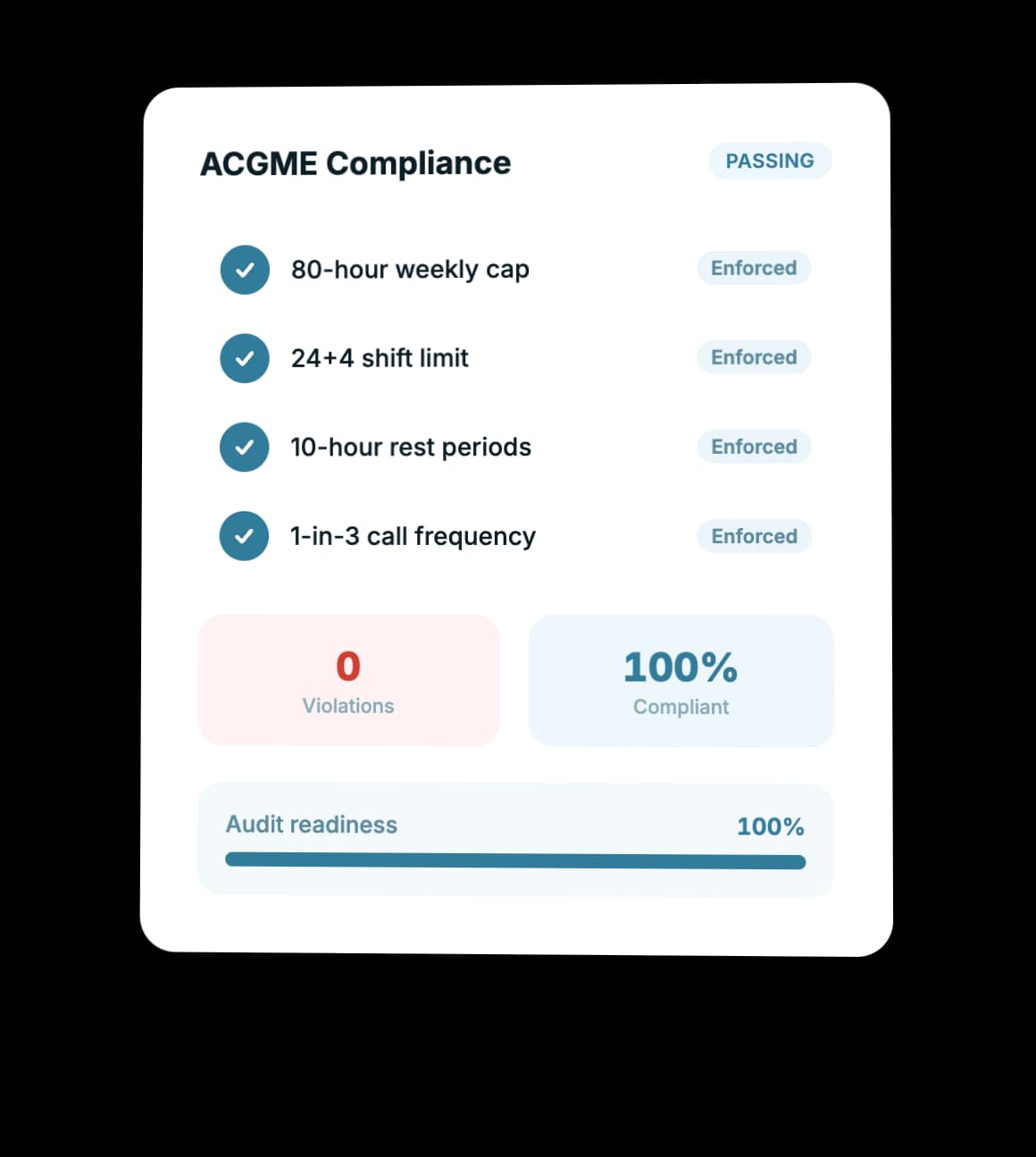
ACGME Compliance Built Into Every Schedule
Duty hour rules are embedded as hard constraints in the mathematical optimization engine. Every generated GME schedule satisfies ACGME requirements at creation time, eliminating the violation-detection cycle that delays distribution.
- Violations prevented at generation
- Audit-ready schedule documentation
- 80-hour and rest period enforcement
Schedule Coordination
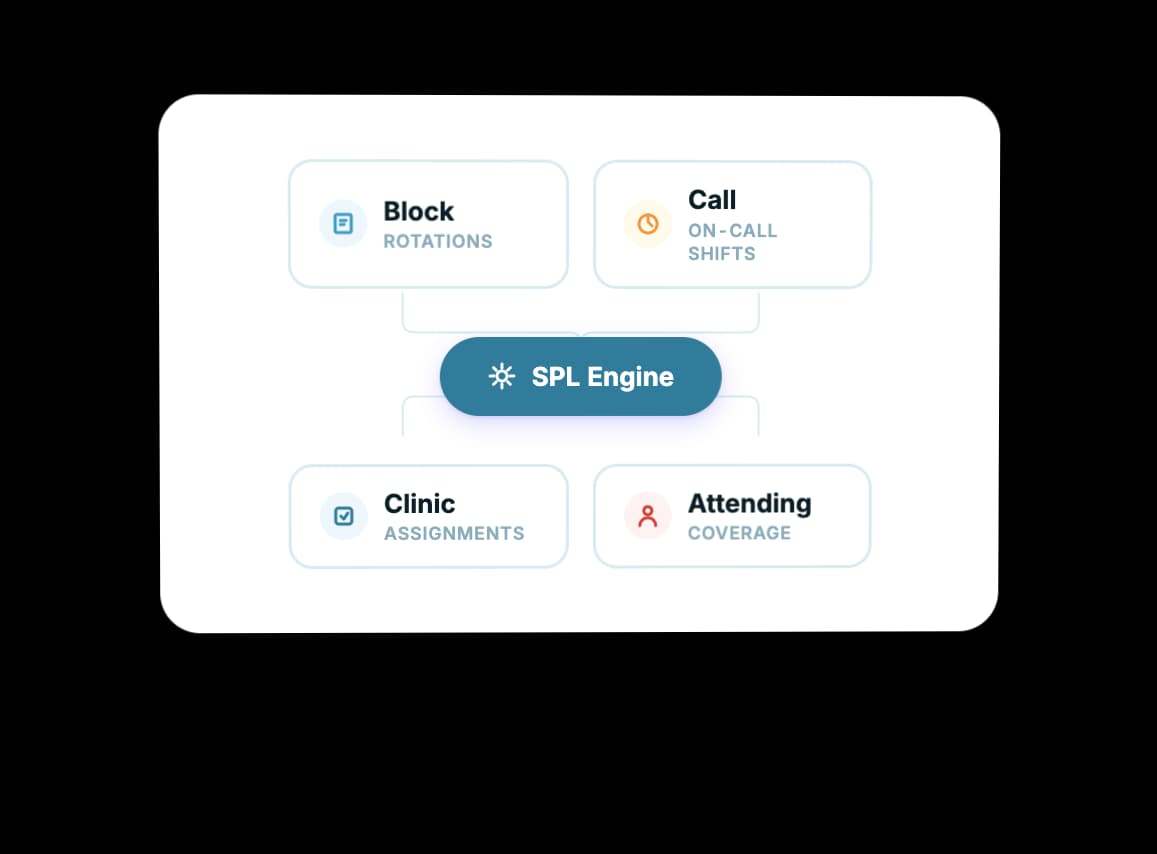
Block Call and Clinic Optimized Simultaneously
All GME schedule types are treated as one interconnected system. A change to a block rotation does not cascade into call or clinic schedules, because all constraints are resolved together before any schedule is finalized.
- Eliminates the domino effect
- Single optimization across all schedule types
- No separate systems causing conflicts
Managed Service
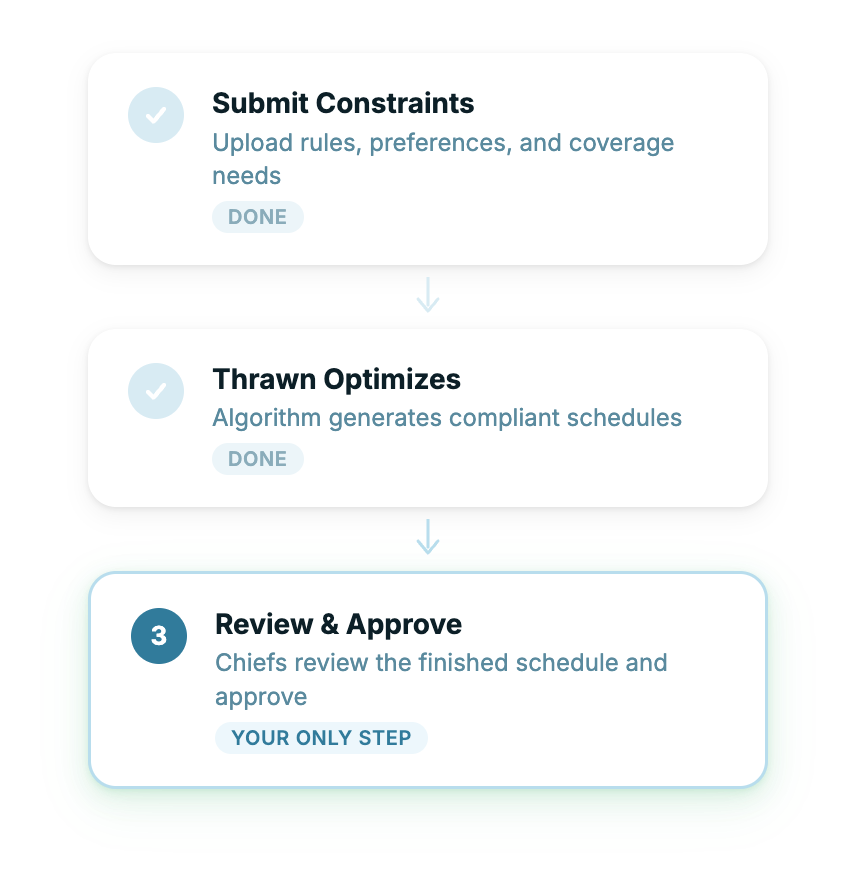
Programs Review Schedules Rather Than Build Them
Thrawn's done-for-you model transforms the role of chief residents and program directors. Your team receives finished schedules for review and approval, completely removing the schedule-building workload from GME administrative staff.
- Zero schedule-building workload
- Clarification rounds before finalization
- Chiefs become reviewers not builders
Fairness Engine
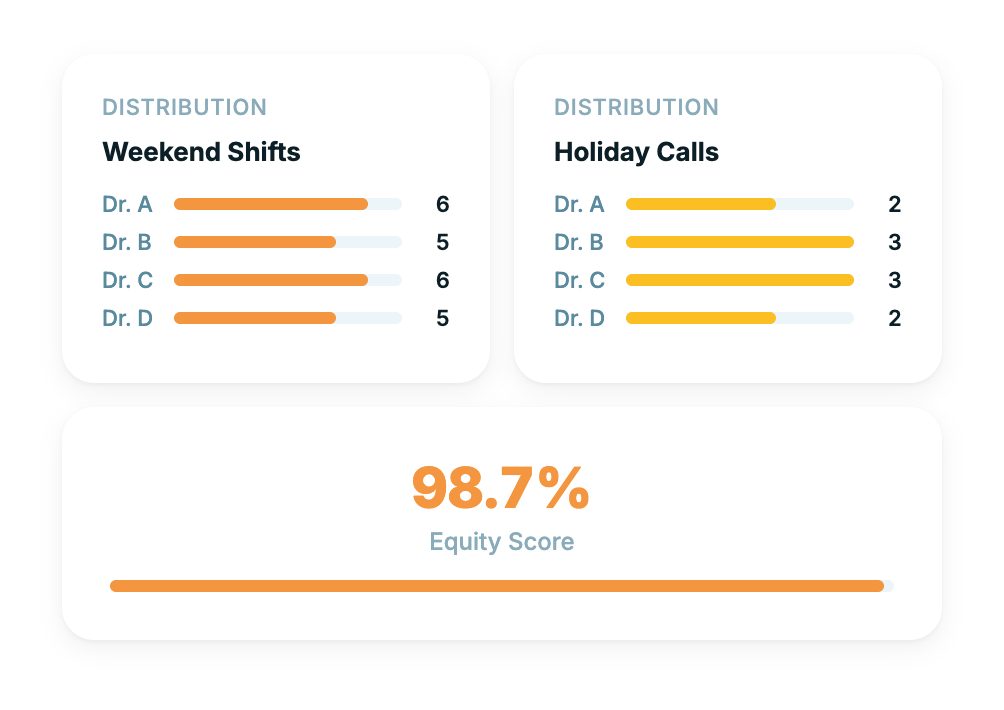
Mathematically Balanced Assignment Distribution
Nights, weekends, holidays, and competitive elective rotations are distributed with mathematical precision across all residents. Bias and the perception of bias are removed, and scheduling complaints driven by perceived unfairness are reduced.
- Equitable night and weekend distribution
- Holiday and holiday-adjacent balancing
- Defensible, measurable fairness
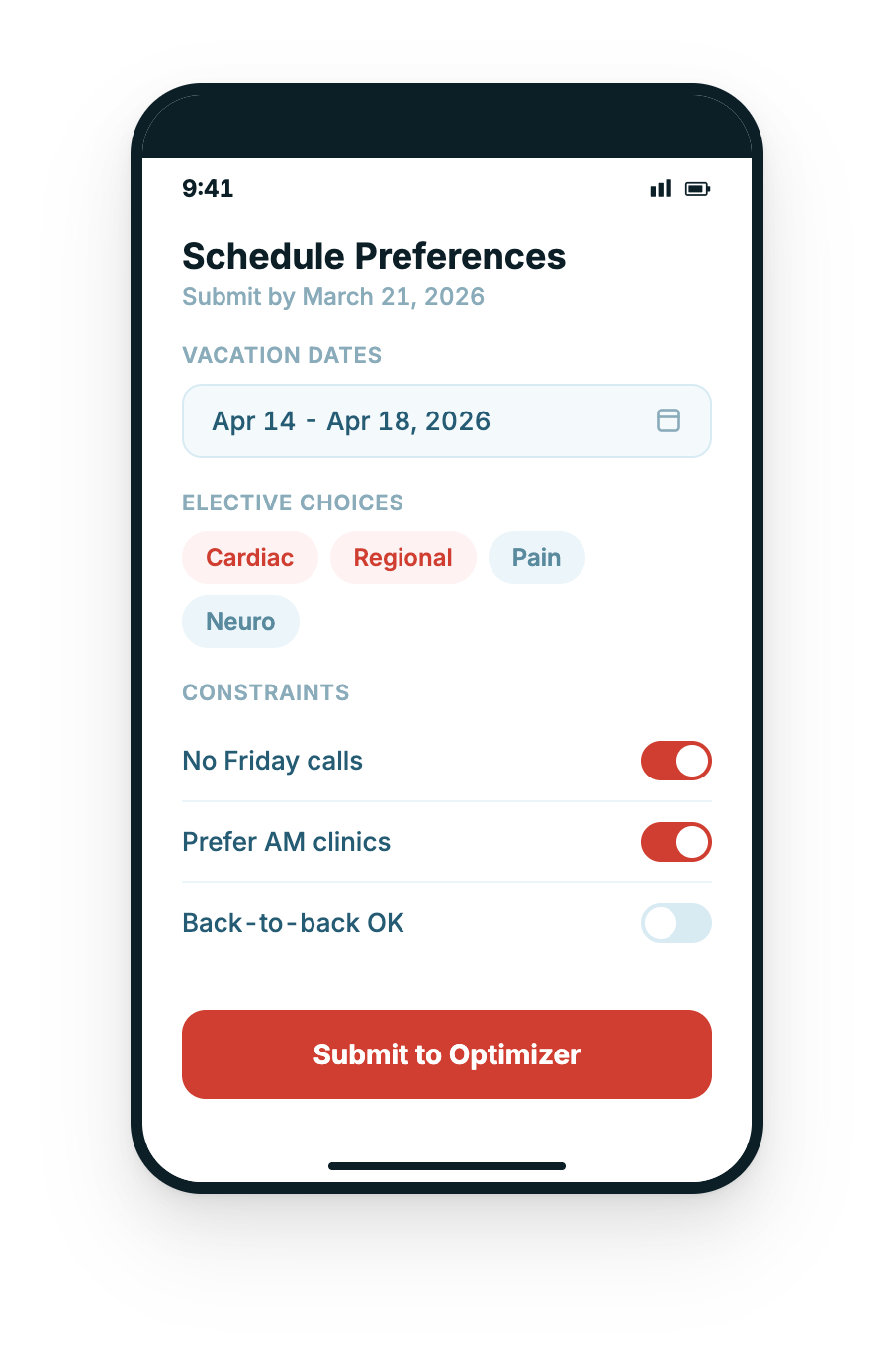
Resident Preferences
Vacation and Elective Preferences Factored In
Resident vacation requests, elective preferences, and individual scheduling constraints are inputs to the mathematical optimization, not manual overrides. Every GME program's preference reconciliation process is handled before the finished schedule is delivered.
- Vacation requests honored in optimization
- Elective preferences as hard constraints
- No manual preference reconciliation needed
Frequently Asked Questions
Ready to Stop Building GME Schedules?
See what a finished, optimized schedule looks like for your program.
Schedule a Consultation