
Automated Residency Block Scheduling That Scales
Thrawn's managed service generates mathematically optimal, conflict-free block schedules from your program's constraints. Chiefs and program directors review finished rotation schedules instead of building them.
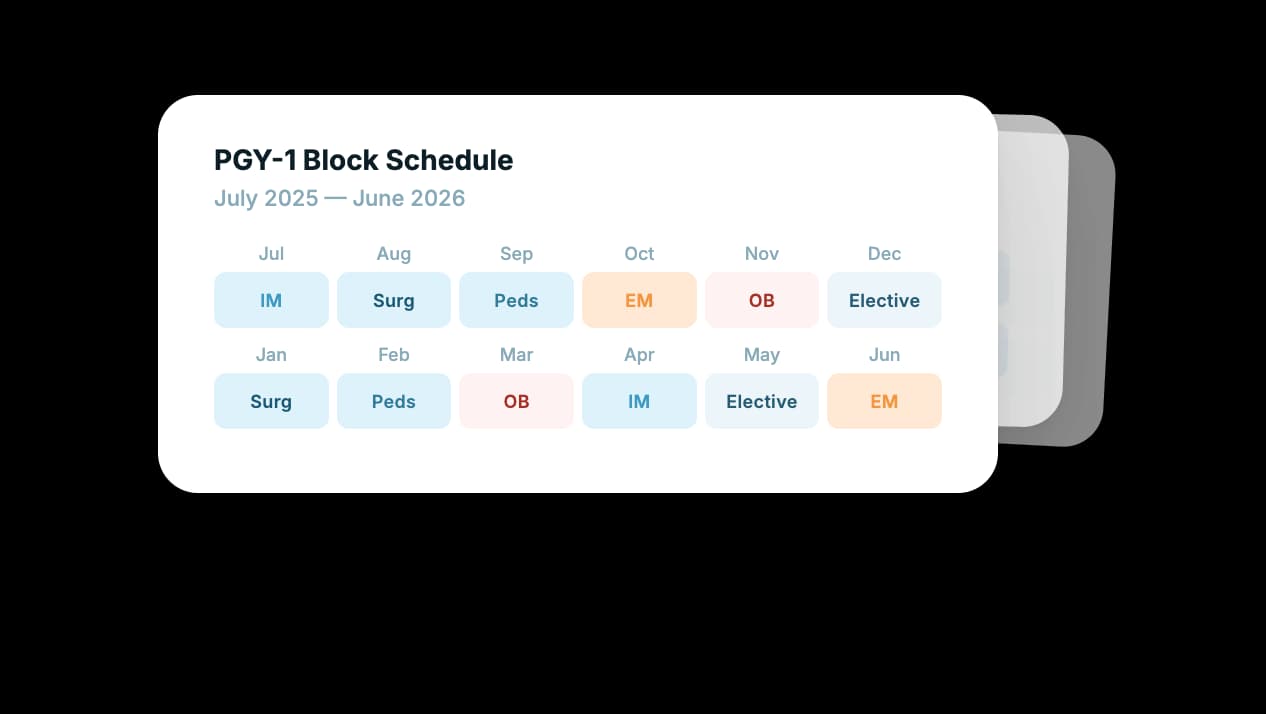
Why Building Block Schedules Breaks Programs
Building a year-long rotation schedule means placing every resident into the right blocks while balancing educational requirements, vacation preferences, coverage mandates, and ACGME rules — all at once. Most programs do this in spreadsheets. Chiefs drag names into cells, manually cross-check conflicts, and rebuild entire sections when one change cascades into twenty. Rule-based scheduling tools can surface conflicts, but resolving them still falls on the chief resident. And when the right resident is moved to fix one conflict, three more appear. The schedule becomes a fragile, load-bearing structure that nobody fully understands — and when a new chief takes over, the institutional knowledge walks out the door.
Why Building Block Schedules Breaks Programs
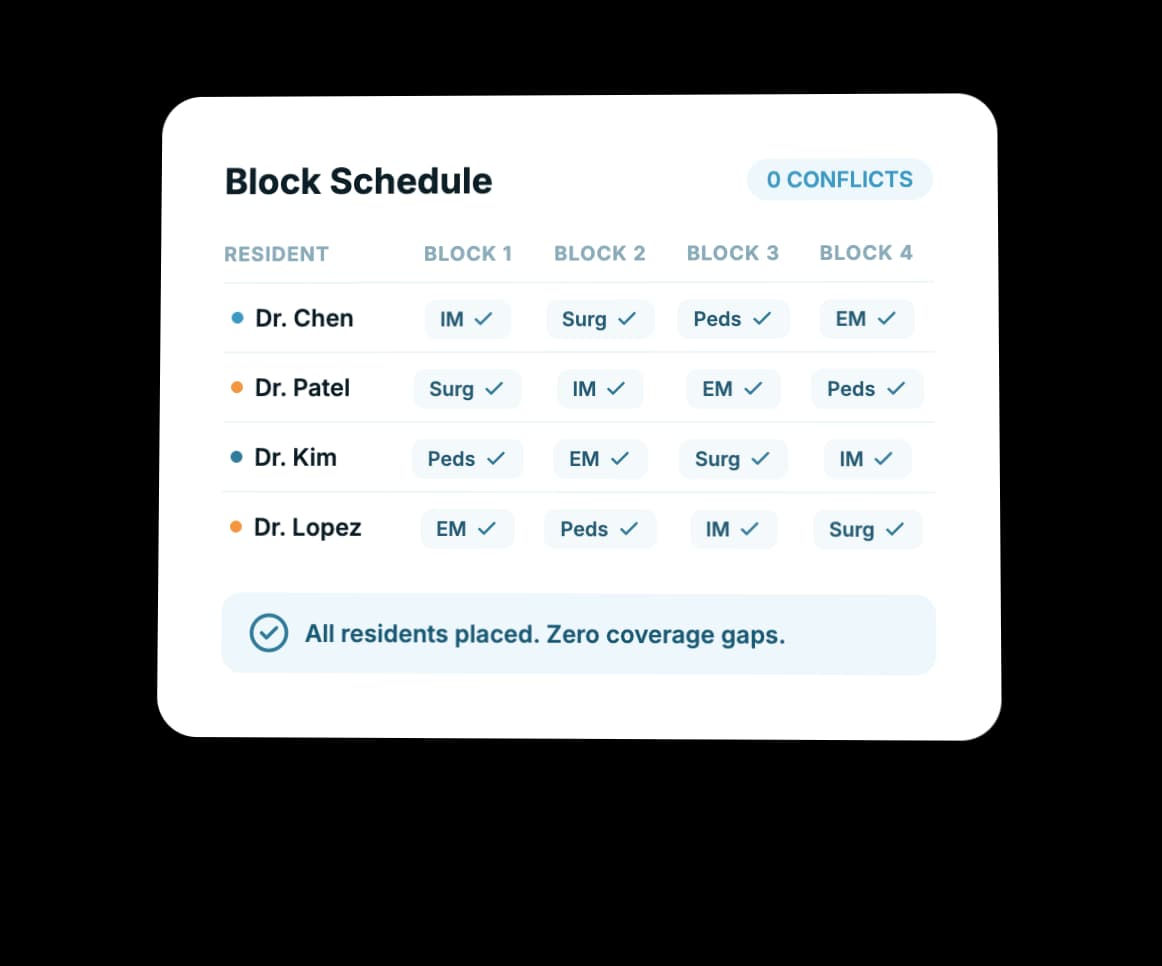
ROTATION OPTIMIZATION
Every Resident In the Right Block
Thrawn's optimization engine encodes every rotation requirement as a mathematical constraint and solves for the optimal placement of every resident across every block. No dragging names, no manual conflict resolution. See how this works for [internal medicine programs](/uses/residency-scheduling-for-internal-medicine).
- Conflict-free rotation assignments
- Coverage gaps mathematically prevented
- Optimal placement across all blocks
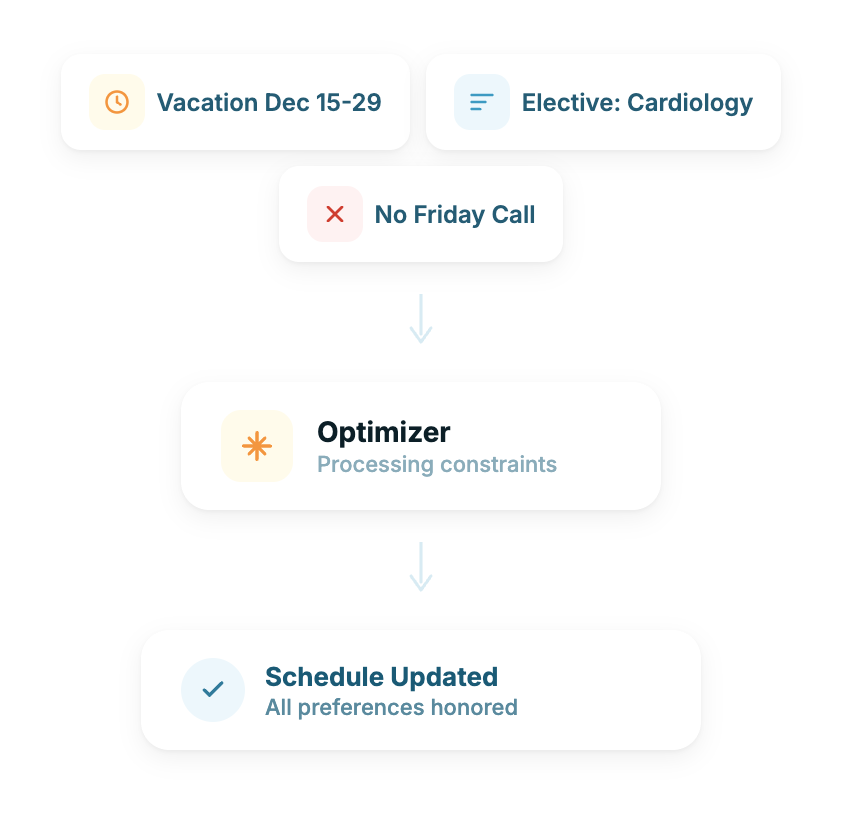
PREFERENCE INTEGRATION
Vacations and Electives Factored In
Resident vacation requests, elective preferences, and scheduling constraints are encoded as inputs before optimization begins — not layered on afterward. The finished schedule reflects preferences without sacrificing coverage or fairness. See how this applies to [family medicine programs](/uses/residency-scheduling-for-family-medicine).
- Vacation requests honored systematically
- Elective preferences encoded as constraints
- Fairness preserved across all residents
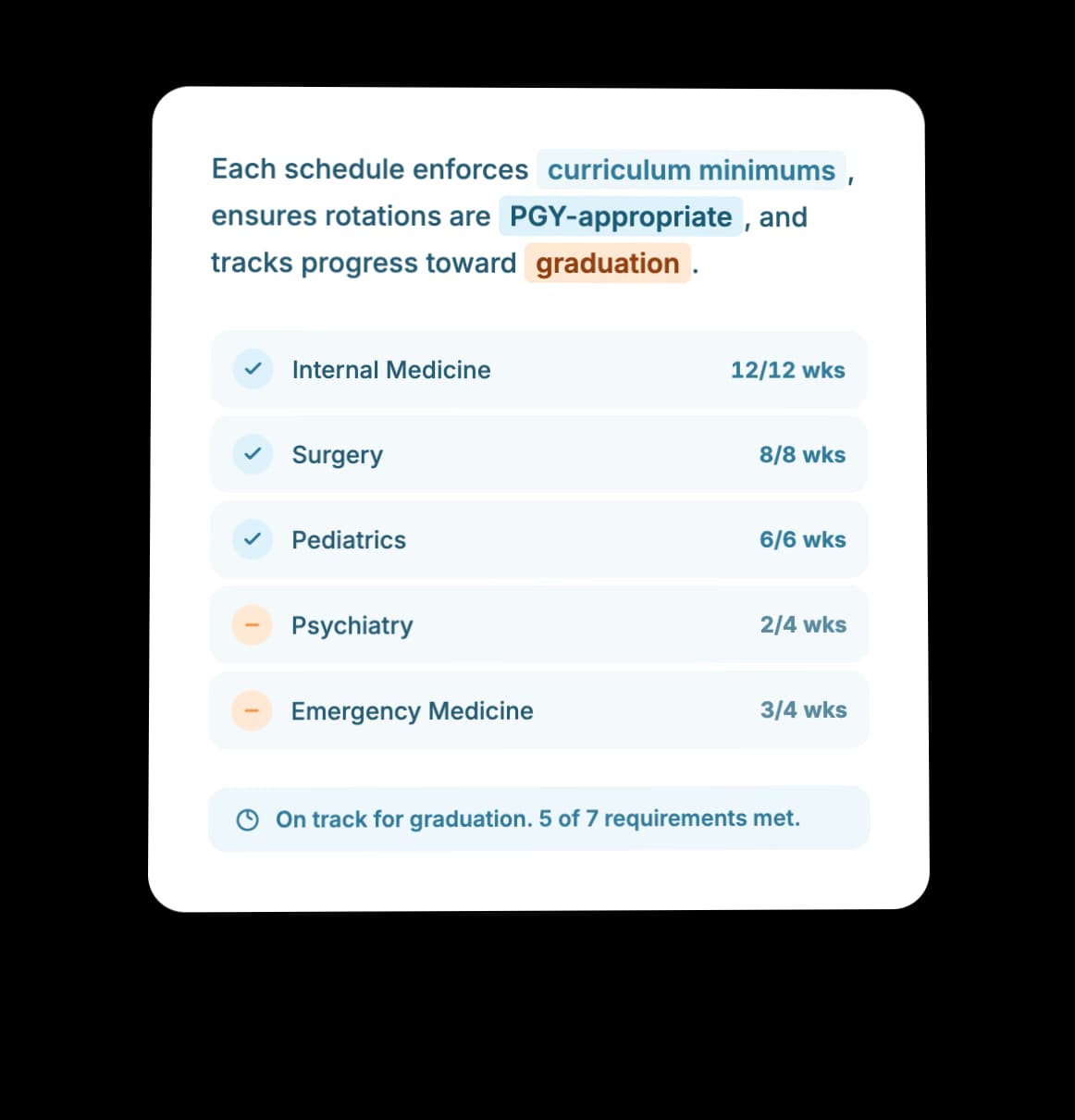
CURRICULUM COMPLIANCE
Graduation Requirements Built Into Every Schedule
Educational milestones, curriculum minimums, and graduation requirements are hard constraints in Thrawn's optimization engine — not a post-build audit. Every resident's training trajectory is satisfied before the schedule is ever delivered for review.
- Curriculum minimums enforced at generation
- PGY-level appropriate assignments enforced
- Graduation tracking built into constraints
YEAR-LONG COHERENCE
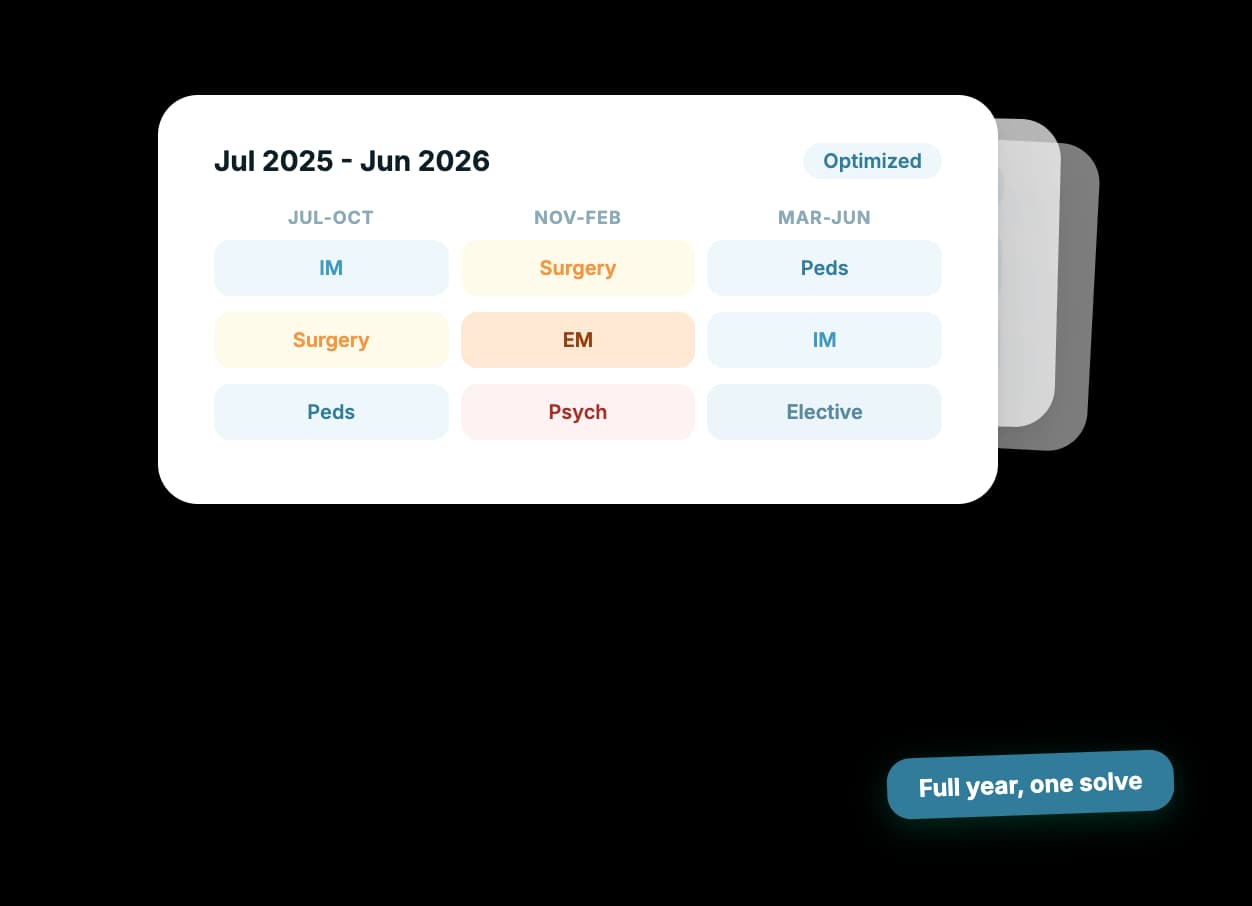
The Full Academic Year as One Optimization
Thrawn treats the entire academic year as a single interconnected optimization problem — not a sequence of monthly puzzles. Every block is placed with awareness of every other block, producing a schedule that holds together from July through June.
- Full-year solved in one pass
- No mid-year structural conflicts
- Coherent across all PGY levels
CHANGE MANAGEMENT
Program Changes Without Cascading Failures
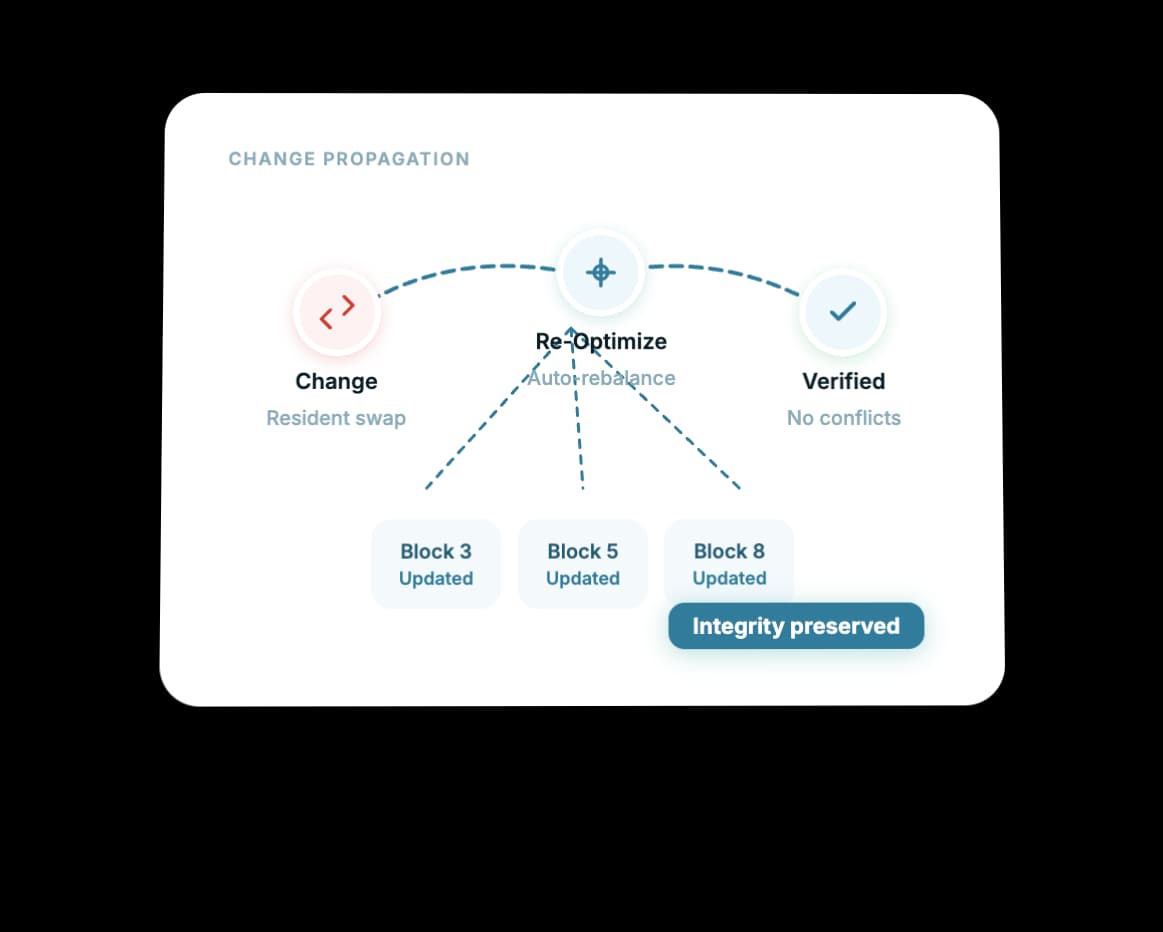
When complement size shifts or program structure changes, Thrawn re-optimizes the affected schedule segments without breaking the rest of the year. Changes propagate safely through the mathematical model rather than manually through a spreadsheet.
- Complement shifts re-optimized automatically
- Downstream blocks updated without manual rework
- Schedule integrity preserved through changes
Get Your Block Schedule Built
Send your constraints and receive a finished, optimized block schedule ready for review.
Get Your Schedule Built