
Residency Call Schedule Automation Fair and ACGME-Compliant
Thrawn's managed service automates call schedule generation with mathematically enforced fairness and ACGME duty hour compliance. Chiefs review finished schedules instead of building them.
Why Call Scheduling Breaks Chief Residents
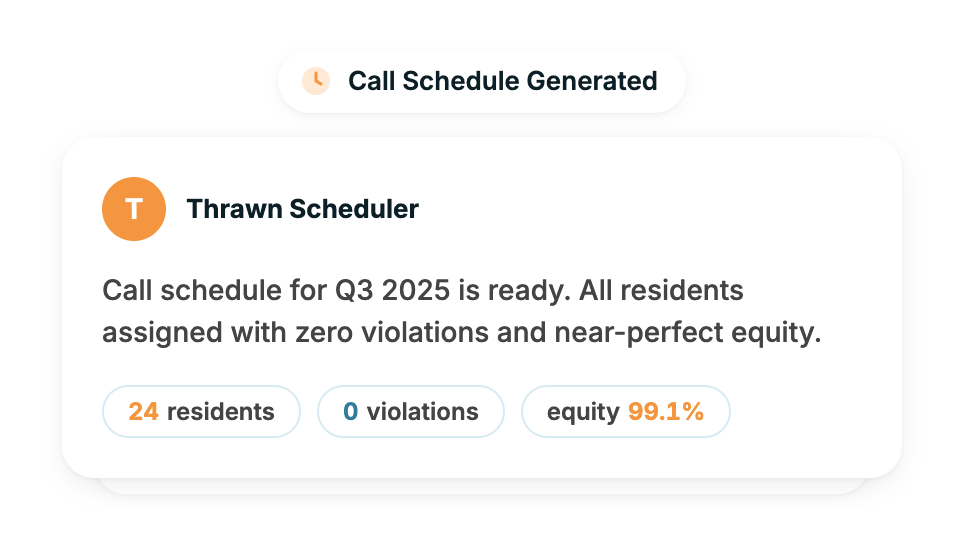
Call scheduling is the most punishing part of residency administration. Every 24-hour shift assignment carries compliance risk. Every weekend and holiday slot provokes complaints about fairness. Post-call rest violations hide inside schedules that look correct until they aren't. Spreadsheets cascade errors across months the moment one resident's constraint changes. Rule-based scheduling tools flag violations after you've already built the schedule, leaving chiefs to manually untangle the mess. Self-serve scheduling software still requires someone to operate it, resolve conflicts, and audit the output. There is no tooling today that treats call scheduling as a mathematical problem with a consistently reproducible answer.
Why Call Scheduling Breaks Chief Residents
MATHEMATICAL EQUITY
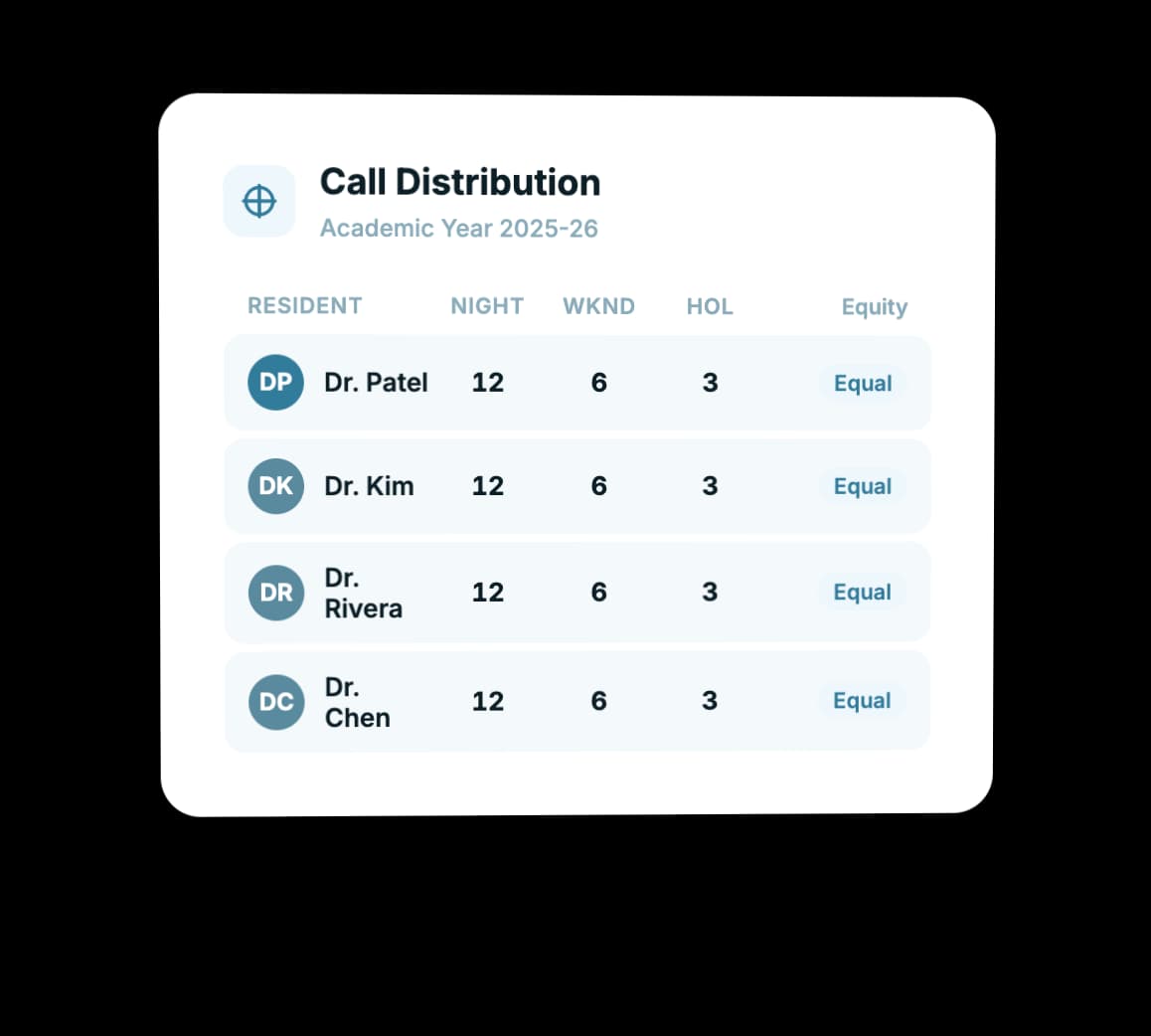
Fair Call Distribution Across Every Resident
Thrawn's optimization engine encodes call equity as a hard mathematical constraint, not a guideline. Every resident receives a measurably balanced distribution of overnight, weekend, and high-burden call assignments across the academic year. See how this works for [general surgery programs](/uses/residency-scheduling-for-general-surgery).
- Overnight call balanced across residents
- High-burden shift equity enforced
- Measurable distribution
PREVENTION NOT DETECTION
ACGME Duty Hours Enforced at Generation
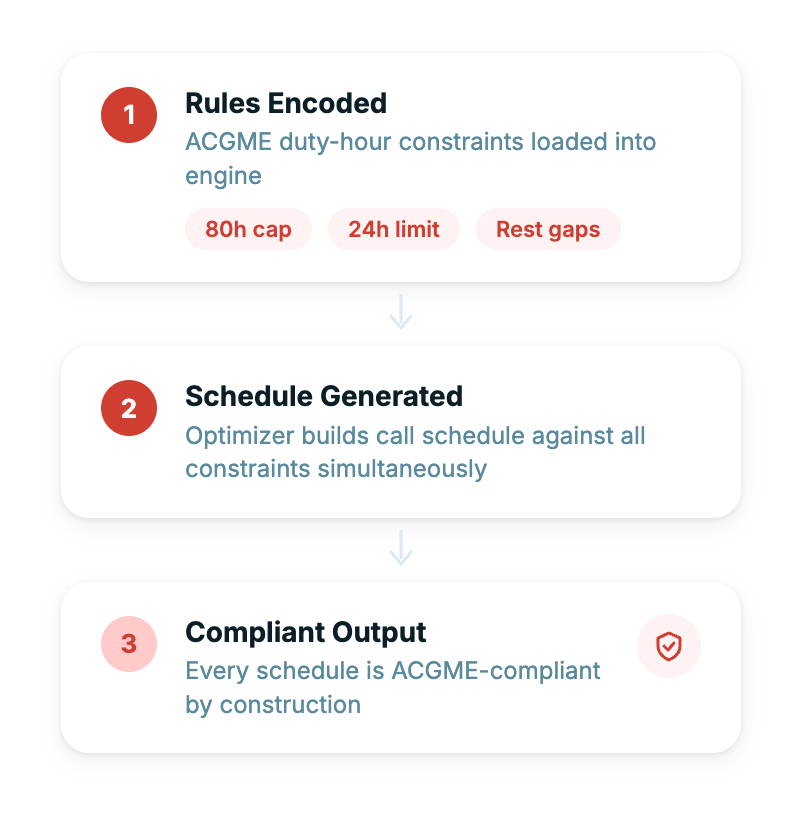
Duty hour rules are encoded as constraints inside Thrawn's optimization engine before the schedule is built. The 80-hour weekly cap, 24-hour continuous duty limits, and mandatory rest requirements cannot be violated in a schedule Thrawn generates. There is nothing to audit afterward.
- 80-hour weekly cap enforced
- 24-hour continuous duty limits
- Mandatory rest period compliance
COMPLEX SHIFT STRUCTURES
Night Float and Jeopardy Handled Natively
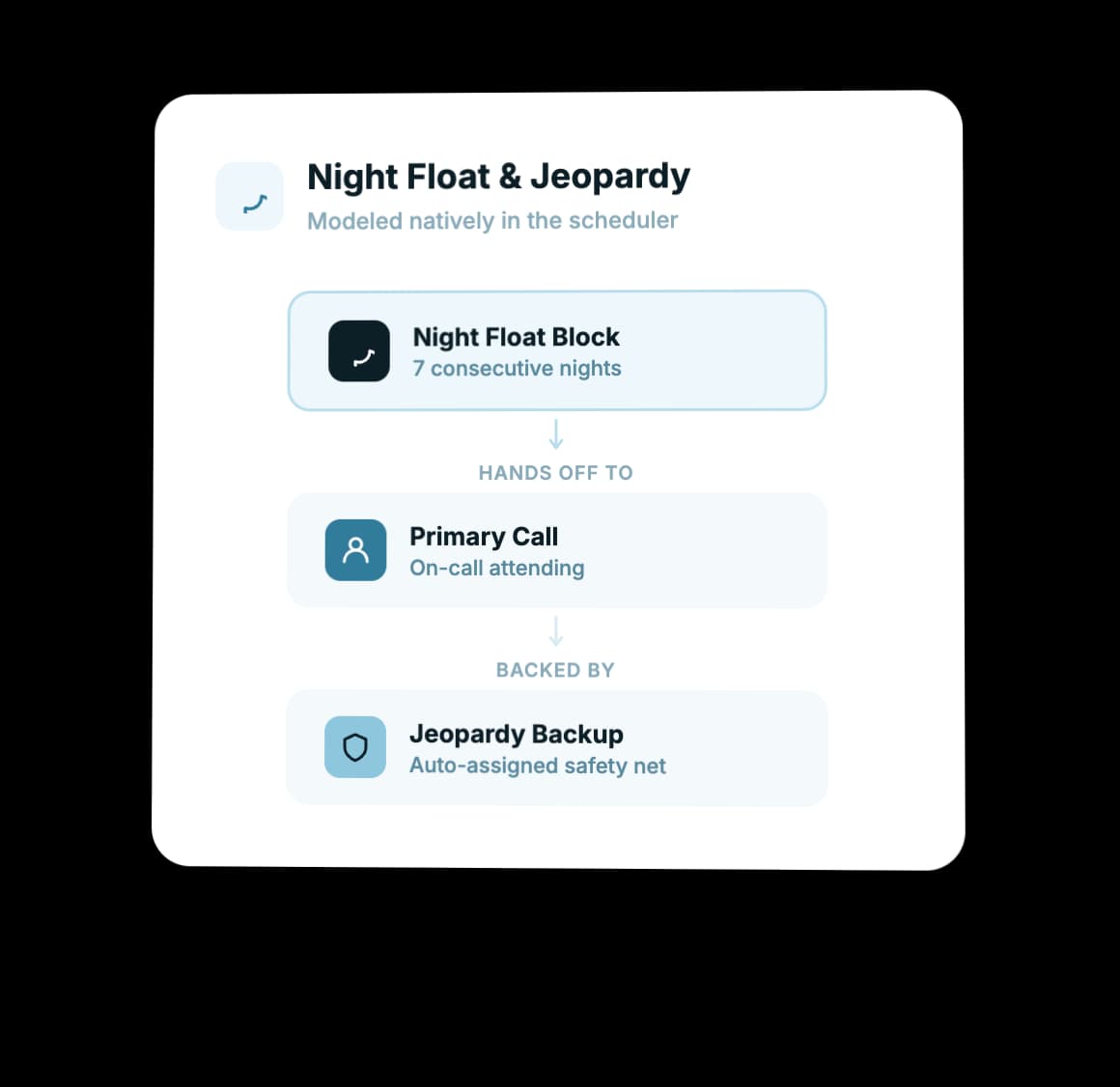
Night float rotations and jeopardy coverage are modeled as first-class structures inside the optimization engine, not workarounds. Coverage chains remain intact across the full academic year without manual patching when residents roll on or off float blocks. See how this applies to [emergency medicine programs](/uses/residency-scheduling-for-emergency-medicine).
- Night float blocks fully modeled
- Jeopardy coverage chains maintained
- No manual patching required
WEEKEND AND HOLIDAY FAIRNESS
Undesirable Shifts Distributed Without Complaints
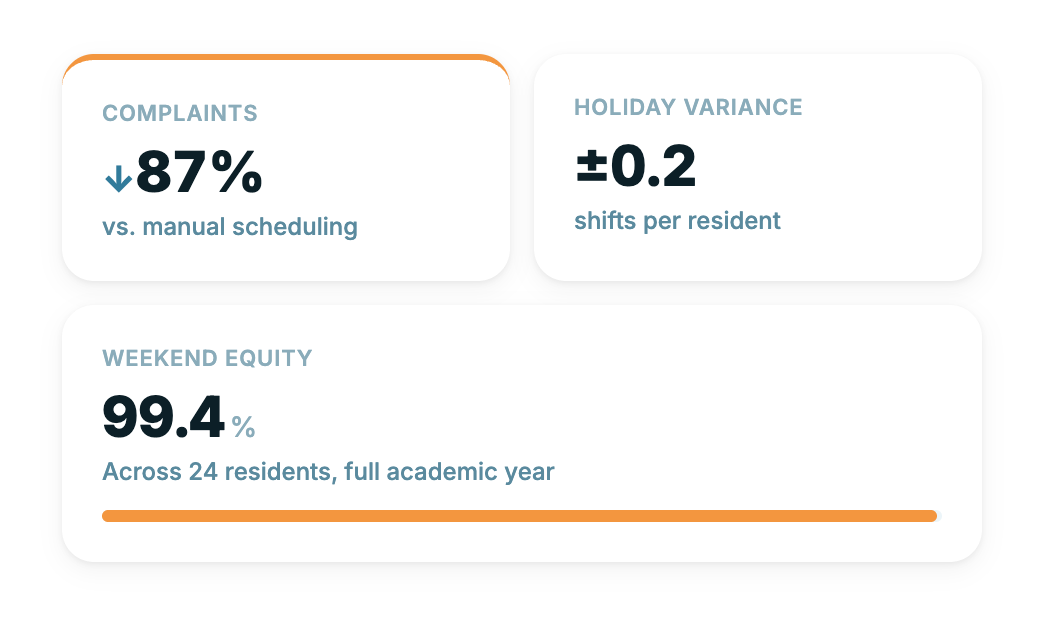
Weekend and holiday assignments are among the most contested elements of any call schedule. Thrawn's fairness engine distributes these shifts with mathematical balance across all residents, eliminating the recurring complaints and accusations of favoritism that plague manually built schedules.
- Holiday shifts equitably assigned
- Weekend burden balanced year-long
- Preference constraints respected
COVERAGE INTEGRITY
Backup and Coverage Call Always Filled
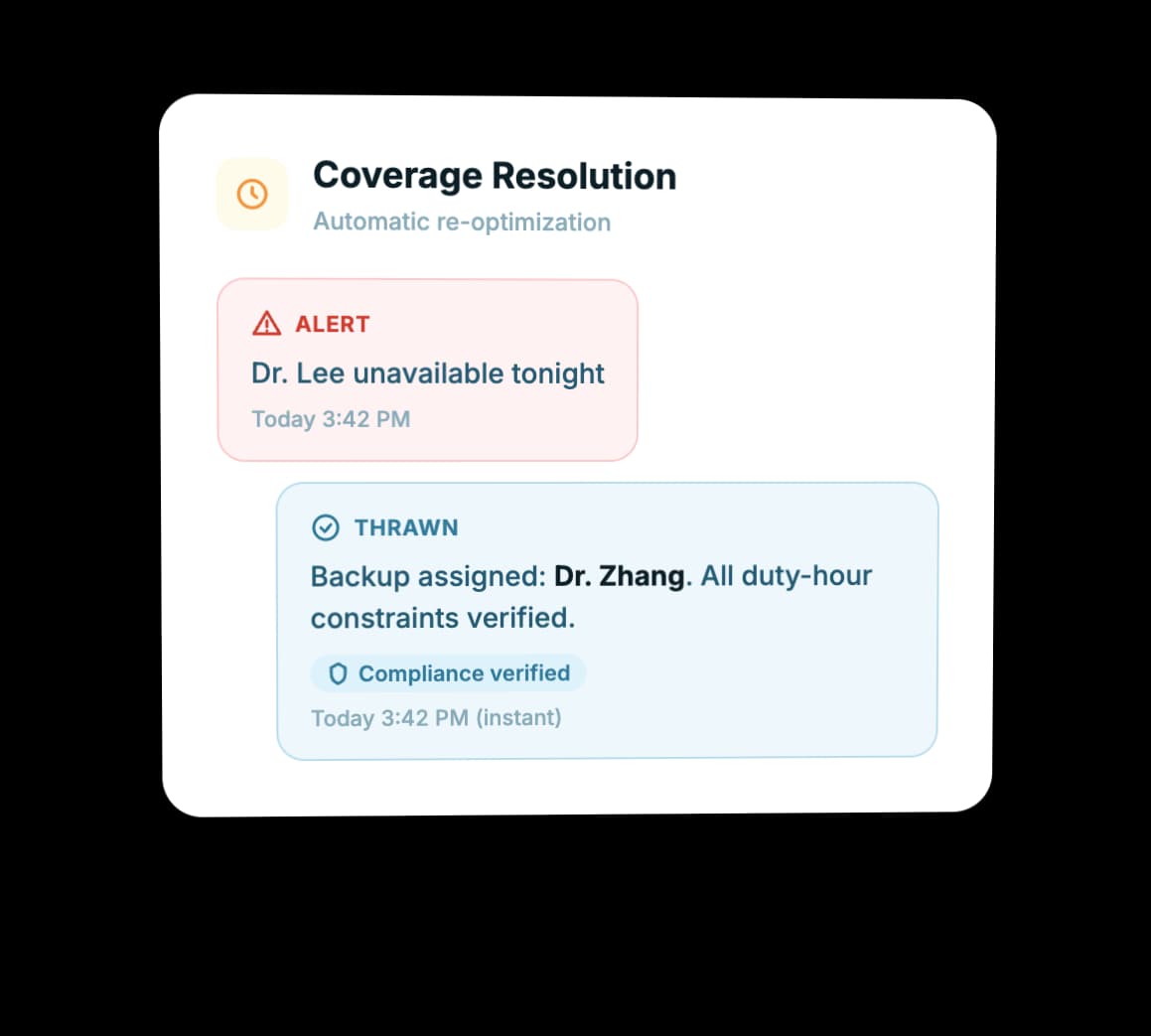
Coverage gaps and unplanned absences are handled through rapid re-optimization rather than manual scrambling. When a resident is unexpectedly unavailable, Thrawn re-generates the affected portion of the call schedule with all ACGME and fairness constraints still enforced.
- Coverage gaps eliminated by design
- Rapid absence re-optimization
- Fairness preserved after changes
Automate Your Call Schedule
Send your constraints and receive a finished, fair, ACGME-compliant call schedule.
Book a Free Walkthrough